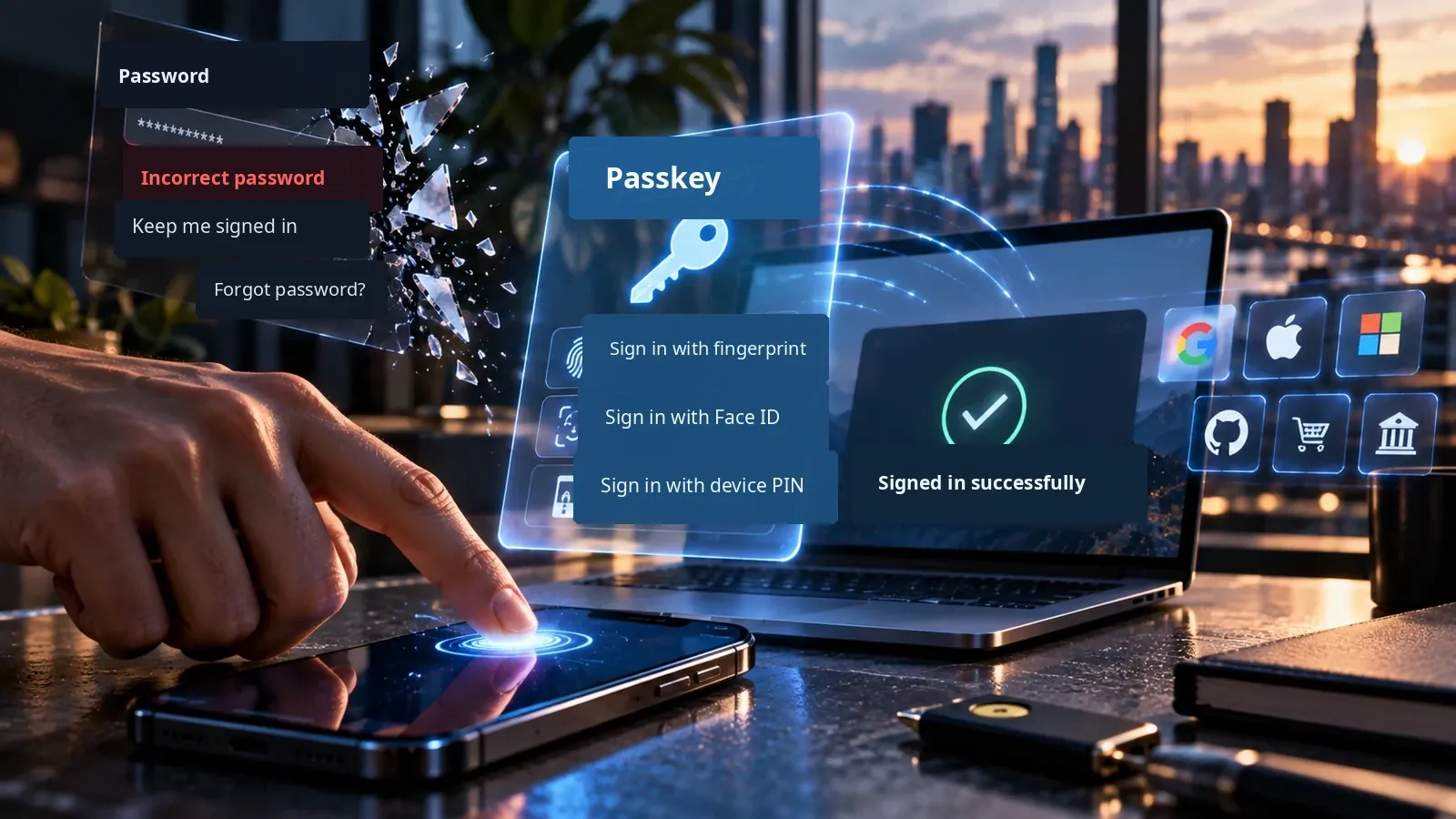
Almost everyone knows the sequence: wrong password, another attempt, then “Forgot password?”. For decades, much of the internet has depended on people remembering secrets. In 2026, that model is beginning to lose its central role.
Passwords were never a good fit for hundreds of accounts
People are expected to create long, unique secrets for every service, never reuse them and never type them into a phishing page that looks identical to the real one. Password managers help, but the shared secret still exists and can still be stolen.
Passkeys change the model: they do not ask people to remember better; they remove the shared password from sign-in.
How a passkey works
Creating a passkey generates a cryptographic key pair. The service stores the public key; the private key remains protected on the device or credential provider. At sign-in, the user unlocks the device with a fingerprint, face recognition or PIN.
The private key is not sent to the website. The device proves possession of the correct credential.
The important change is not a better password. It is the disappearance of the shared password itself.
Why passkeys resist phishing
A fake site can steal a password because a user can type the same secret into the wrong place. A passkey is bound to the legitimate service and cannot simply be handed to another domain.
Biometric data stays on the device. The website does not receive your fingerprint or face template as the credential.
2026: from optional feature to mass adoption
The FIDO Alliance reported around five billion active passkeys worldwide in 2026. Adoption is no longer limited to security enthusiasts.
Platforms, operating systems and enterprise identity products are integrating passkeys into ordinary sign-in flows.
Microsoft is accelerating the transition
From September 2026, Microsoft Entra ID makes passkeys the preferred method for many users. From February 2027, Microsoft also begins retiring its own SMS and voice authentication delivery in many scenarios.
It is a clear signal that major providers are favouring phishing-resistant methods.
Two-factor authentication is still useful
Not all second factors provide the same protection. SMS can be attacked through social engineering, SIM swapping and real-time phishing.
Passkeys and FIDO2 aim to remove the reusable secret instead of simply adding another code.
Your fingerprint and Face ID are not sent to the website
Biometrics are a local check that authorises use of the passkey. The remote service does not receive your fingerprint or face template.
Biometrics unlock the private key; they are not the passkey itself.
Losing a phone makes recovery critical
Major ecosystems support protected synchronisation, security keys and other recovery paths. Without them, losing one device could mean losing too many accounts.
The new security question is how to protect devices and recover identity without creating an easy bypass for attackers.
Account recovery becomes a target
A strong passkey helps little if support can reset access after a weak identity check. Attackers will target the easiest link.
Balancing legitimate recovery with fraud resistance will be one of the major challenges of a passwordless internet.
Password managers are not disappearing yet
Billions of accounts still use passwords and legacy systems will remain for years. We will live in a mixed world of passkeys, passwords, PINs and security keys.
The role of password managers is changing toward broader management of credentials, passkeys and identity.
The smartphone becomes a digital key ring
Banking, payments, messages, tickets and authenticator apps already live on the phone. Passkeys make the device even more central.
A strong device PIN, biometrics, updates, remote wipe and secure recovery therefore matter more, not less.
AI agents create the next authentication problem
Agents will increasingly book travel, retrieve documents and use services on our behalf. Systems will need to know not only who the human is, but what rights have been delegated to the agent.
Permissions should be limited by task, time, amount or data. Future authentication will ask who is acting, for whom, with what permission and for how long.
Is this really the end of the password?
Not tomorrow. The internet is too large and full of old systems. But 2026 is a turning point: passkeys have reached billions and major providers are moving them from option to default.
The password may never disappear on one dramatic date. It may simply become less relevant until people realise they have not typed one for months. The deeper change is digital identity: proving who we are through protected cryptographic credentials instead of a secret we must remember.