As of: 29 September 2026
There is a difference between having seen something and truly engaging with it.
We open our phones in the morning and read headlines. We watch short videos, comments, messages, photos, recommendations and clips from longer conversations. By evening, we may have taken in hundreds of individual pieces of content.
And yet a simple question can sometimes be difficult to answer:
What actually stayed with us?
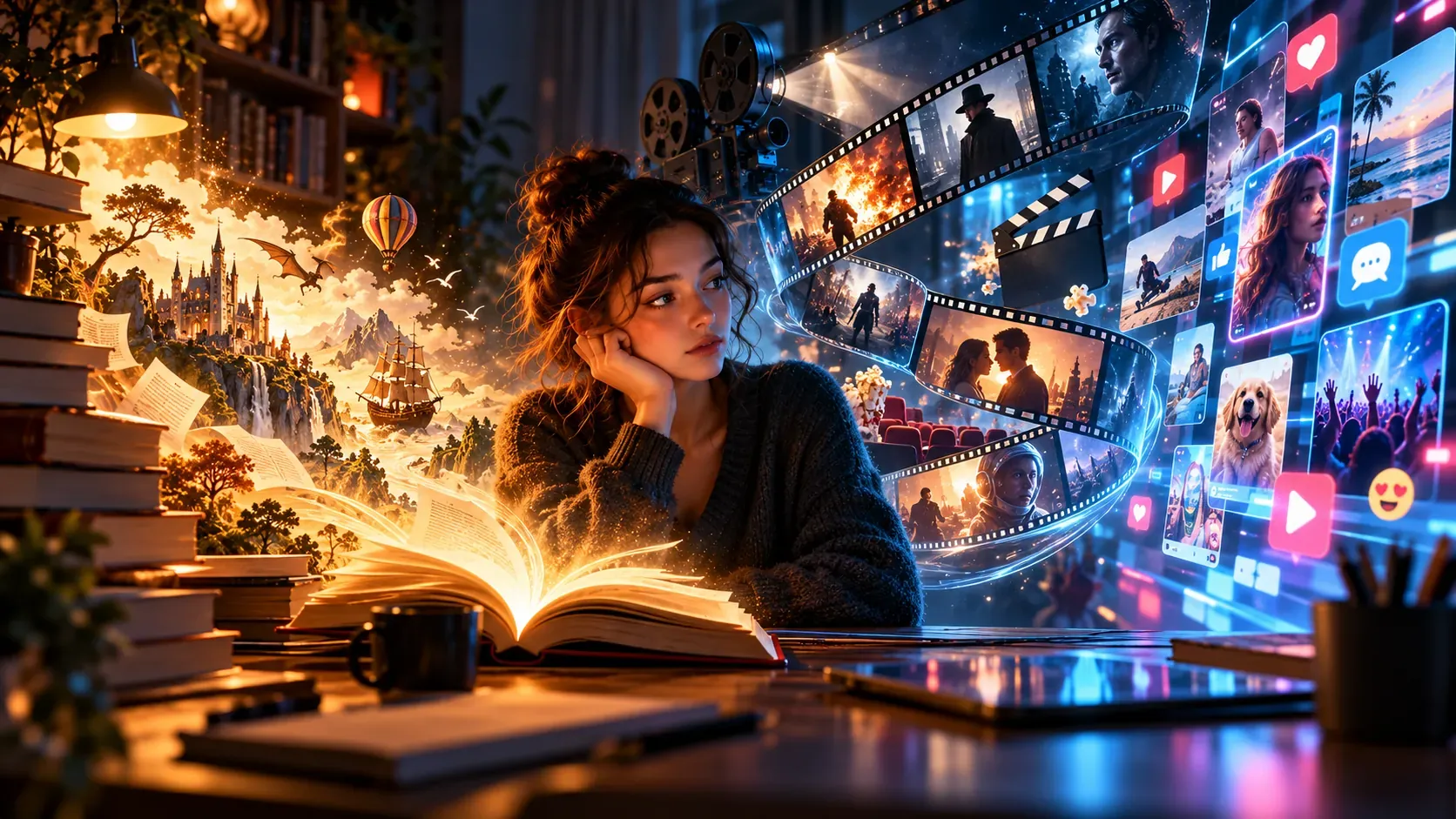
Never before have people had such fast access to so much information, so many stories and so many opinions. At the same time, a book no longer competes only with other books. It competes with streaming services, social media, podcasts, games, news, chats and a device that can deliver a new stimulus at any moment.
That quickly leads to a provocative claim:
People do not read anymore.
It is not that simple.
Current data do not show a single clear trend. In some groups, reading for pleasure is falling sharply. At the same time, books still generate billions in revenue, print remains important, e-books and audiobooks have reached new audiences, and fiction is even growing in some markets.
So the deeper change may be less about reading disappearing.
It may be about how attention is distributed.
A book is now just one option among many
A few decades ago, people looking for entertainment had fewer options available at the same time.
Today, competition does not begin in the bookshop.
It begins on the lock screen.
A message appears. Then a video. Then a recommendation. A new episode is waiting. A friend sends a link. An app reminds us that we have not watched anything for hours. An algorithm immediately offers something new.
A book, by contrast, has an unusual quality:
It does not push itself at us.
It does not vibrate.
It does not launch an autoplay preview.
It does not automatically start the next thing when a chapter ends.
To read, we have to make a deliberate choice.
That is precisely where its strength lies — and also its disadvantage in an environment competing for attention.
Are people actually reading less?
The answer depends on who is being asked, which country is being studied and what counts as reading.
In the United States, according to a Pew Research Center survey conducted in October 2025, 75 percent of adults said they had read at least part of a book in some format during the previous twelve months.
64 percent had read a printed book, 31 percent an e-book and 26 percent had listened to an audiobook.
The longer-term trend is especially interesting.
According to Pew, the share of adults who had read a printed book fell from 72 percent in 2011 to 64 percent in 2025. At the same time, the use of e-books and audiobooks rose substantially.
The overall share of people reading books in any format, however, remained relatively stable over many years.
That does not fit the simple narrative of “the end of reading.”
It points instead to a shift in formats.
Among young people, the trend looks more troubling
A much more concerning picture appears when looking at reading for pleasure among children and teenagers.
In 2024, the UK’s National Literacy Trust analysed responses from more than 76,000 children and young people.
Only 34.6 percent of 8- to 18-year-olds said they enjoyed reading in their free time.
According to the organisation, that was the lowest figure since the survey began in 2005.
Only 20.5 percent said they read daily in their free time.
That was also a record low.
More recent National Literacy Trust analyses from 2026 describe the decline in reading enjoyment and daily reading, especially during adolescence, as an ongoing major challenge.
These figures cannot automatically be applied to every country.
But they suggest that something may be at risk for at least part of the younger population: reading for pleasure in their free time.
Does less reading automatically mean more TikTok and streaming?
Here too, caution is needed.
It is tempting to look for a single culprit behind every change.
Smartphones.
TikTok.
YouTube.
Streaming.
Video games.
But people read less for many different reasons: lack of time, school, work, limited reading encouragement, weak reading skills, stress, other hobbies or simply a lack of interest.
Digital media are part of that environment, but they are not the only cause.
Even so, they change the competition for attention.
A book normally asks us to stay with the same content for an extended period.
Many digital formats work differently.
They make rapid switching easy.
Do not like a video? Swipe on.
Not interested in a headline? Scroll past it.
A podcast gets boring? Skip ahead.
Not into a series? Pick another.
That is convenient.
But convenience changes habits.
The difference between reading and consuming
“Consuming content” can sound dismissive.
It does not have to be.
A film can be demanding and sophisticated.
A podcast can explain complex issues.
A good video can convey knowledge that might once have required several pages of text.
The format itself is not the problem.
It arises when media use consists mainly of fast, interchangeable stimuli.
Attention then becomes fragmented.
We jump from one topic to another before any of them has time to develop depth.
A book usually works according to a different logic.
It expects patience.
A character has to develop.
An argument has to be built.
A world has to emerge.
Sometimes the first thirty pages are not spectacular.
But that slowness can enable something short formats often struggle to provide: coherence.
Reading forces us to create the images ourselves
In a film, we see what a room looks like.
We hear a character’s voice.
We see their face.
We hear music telling us whether a scene is threatening, sad or romantic.
When we read, much of that is absent.
The brain has to fill in the gaps.
What does the street look like?
How does this person speak?
How quickly do they move?
What does the room feel like?
Two people can read the same novel and form completely different inner images.
This active imagination is one of the distinctive qualities of reading.
That does not mean books are automatically “better” than films.
Film works with different tools.
But reading allows more of a world to be created inside the reader’s mind.
A book is harder to take in while doing something else
Many forms of media now accompany other activities.
A series plays while we eat.
A video runs while we tidy up.
A podcast plays in the car.
Music runs while we work.
There is nothing inherently wrong with that.
But a demanding text is difficult to read while doing something else.
Anyone trying to read a page while paying attention to three other things quickly notices that the text does not stay in the mind.
Reading demands a form of presence.
We can drift off, of course.
But then we have to go back.
Read a paragraph again.
Remember where a character fits into the story.
Reconstruct an argument.
A book makes it quite obvious when our attention has wandered.
The smartphone is not automatically the enemy of the book
This is precisely where nuance matters.
A smartphone can displace reading.
But it can also make reading possible.
People read e-books on their phones.
They discover authors through social media.
They follow book clubs.
They buy books after seeing recommendations in videos.
They listen to audiobooks on the way to work.
They discuss novels with people they would never have met offline.
Digital platforms have not only created competition.
They have also made books more visible.
Phenomena such as BookTok have shown that short videos and long books do not have to be natural enemies.
A thirty-second video can lead someone to read a five-hundred-page novel.
So the key question is not:
Digital or book?
But rather:
What do we use digital media for?
Printed book or screen — which is better?
There is no simple answer to that either.
A meta-analysis published in 2024 covering 37 experimental studies found no significant overall difference in reading comprehension between digital reading and reading on paper.
However, the result depended on a number of conditions.
Other large meta-analyses from earlier years found a small advantage for paper in certain tasks, especially with informational texts or under time pressure.
So the research does not support a simple “paper good, screen bad” conclusion.
An e-reader without constant notifications is very different from a smartphone on which messages, videos and apps compete for attention while someone is trying to read.
The medium is only one part of the situation.
The real problem is interruption
Someone who reads a book but checks their phone every two minutes is still technically reading.
But the experience changes.
A novel depends on memory.
A non-fiction book depends on arguments that build on one another.
When attention is constantly interrupted, the mind has to keep finding its way back.
Who was this character?
Why did this detail matter?
What was the author’s last point?
The loss does not necessarily come from reading on a screen.
It comes from never giving one piece of content uninterrupted time.
Is our attention span really getting shorter and shorter?
This claim is repeated frequently.
We often hear that people today have an attention span of only a few seconds.
Such sweeping figures are scientifically problematic.
Attention is not a fixed number that is identical for every person in every situation.
Someone may close a boring video after a few seconds and still spend three hours playing a game, watching a film, programming or reading a novel.
That shows:
The problem is not simply the ability to pay attention.
It is also about motivation, stimulus density, habit and the expectation of how quickly something has to become interesting.
Perhaps, then, our attention has not disappeared.
Perhaps we have simply become more accustomed to reallocating it quickly.
Why books can start to feel “difficult” again
After a long period without regular reading, a book can feel surprisingly slow.
Not much happens on the first pages.
We have to learn names.
Understand a world.
Read sentences more than once.
There is no progress indicator delivering a reward after ten seconds.
Someone used to rapid changes in media may initially experience that slowness as boredom.
But boredom is not automatically proof that the material is bad.
Sometimes it is simply the transition from constant external stimulation to sustained concentration.
People who do not give up after ten minutes often find that their attention begins to settle.
It is similar to other habits.
What has become unfamiliar initially feels harder.
The book market is not disappearing
Market data also argue against the idea that books are close to extinction.
In the United States, according to the Association of American Publishers, the publishing industry generated around 33.4 billion US dollars in revenue in 2025.
Of that, around 21.7 billion US dollars came from the trade sector, meaning books for the general public.
Printed formats continued to dominate there.
Hardcover and paperback together accounted for 73.1 percent of trade revenue.
The picture in Germany is also more nuanced.
According to data from the German Publishers and Booksellers Association, unit sales across five major sales channels fell by 4.9 percent in 2025 compared with the previous year.
At the same time, fiction revenue increased by 1.3 percent.
Books are therefore not simply being replaced by digital media.
The market is changing, but it still exists on a substantial scale.
Do we buy books we never read?
Almost everyone who likes books knows the phenomenon.
A book is bought because the title sounds interesting.
A second one is already sitting on the bedside table.
A third is recommended.
A fourth is discounted.
At some point, the pile grows faster than the time actually available to read.
That is not necessarily a problem.
Books are also cultural objects.
People own them because they hope to find time for them later, because they want knowledge within reach or because a library is part of their identity.
But the phenomenon reveals an interesting distinction between access and use.
Today we can buy, download or save more books than ever before.
That does not automatically mean we have more time to read them.
The same applies to films, series, podcasts and saved articles.
Our lists grow.
Our time does not.
Audiobooks: reading, or something else?
This question is debated with surprising emotion.
Someone listening to an audiobook processes a story differently from someone reading printed text.
Their eyes are not decoding words.
The pace is influenced more strongly by the narrator.
Even so, language, plot, characters and arguments are still being processed.
For many people, audiobooks are therefore not competition for reading but an additional way of accessing literature.
They make it possible to experience books while commuting, walking or doing activities where reading a printed book would be impossible.
The growth of audiobooks is therefore not necessarily a sign of the decline of books.
It can just as easily mean that stories are finding new spaces in everyday life.
Why long texts still matter to society
Some subjects cannot be meaningfully reduced to three sentences.
War.
Migration.
Economics.
Technology.
History.
Psychology.
Politics.
Relationships.
A short post can draw attention to a subject.
But understanding often requires context.
Someone who consumes only summaries may learn the conclusion of an argument, but not the route that led to it.
That route matters.
It is where uncertainties, counterarguments, assumptions and details are found.
Long texts do not automatically teach critical thinking.
But they create room for it.
A book asks us to tolerate contradictions
Short media formats work especially well when a message can be understood quickly.
Good or bad.
Right or wrong.
Winner or loser.
Scandal or success.
A novel, by contrast, can spend hundreds of pages showing a character who is both sympathetic and troubling.
A non-fiction book can examine a subject without offering a simple solution after five paragraphs.
That ambiguity has value.
Real life rarely comes in neatly resolved statements.
Reading can therefore be an experience in which we have to live with uncertainty for longer.
We do not yet know what to think.
And we keep reading.
Films and series do not replace books
Film and literature are also often pitted against each other.
Yet they tell stories with entirely different tools.
A film can create an atmosphere in seconds that a novel may need several pages to establish.
A novel, meanwhile, can enter thoughts directly, stretch memories and reveal inner contradictions that are difficult to portray on screen.
So the question is not which medium is superior.
The more interesting question is whether we are still willing to give one work our attention for an extended period.
Because films, too, are increasingly watched while people do something else.
People reach for their phones during a scene.
They reply to messages.
They read comments about the film while the film is still playing.
The same attention problem has therefore long since moved beyond books.
Maybe we are not reading less — just differently
The internet has not abolished reading.
Quite the opposite.
People read all day.
Chats.
Comments.
Subtitles.
News.
Product reviews.
Forums.
Posts.
Emails.
Instructions.
Search results.
The amount of text a person sees each day can be enormous.
But this reading is often fragmented.
A sentence here.
A paragraph there.
A comment underneath.
Then on to the next thing.
So perhaps the better distinction is not:
Reading or not reading.
But:
fragmented reading or sustained reading.
What is different about slow reading
A longer text forces information into a sequence.
Page 120 works only because page 20 came first.
A character gains meaning because we already know them.
An argument succeeds or fails because foundations were laid earlier.
That structure demands memory and concentration.
We have to retain something while new material is added.
That is precisely why sustained reading can feel more demanding than a stream of short content.
But effort is not automatically a disadvantage.
It is part of the activity.
How to read more again without turning it into a self-improvement project
Reading does not have to become a competition.
There is no prize for finishing fifty books a year.
Someone who reads three books attentively has not automatically “read less” than someone who skims twenty.
What matters is whether reading has a place in everyday life.
A few simple conditions help more than grand resolutions.
Do not put the smartphone directly next to the book.
Do not try to answer messages at the same time.
Choose a book that genuinely interests you — not one you think you ought to read.
Start with twenty minutes.
Stop if, after giving a book a fair chance, you truly do not like it.
Reading is allowed to require concentration.
But it does not have to be a punishment.
Books do not have to defeat the internet
Perhaps that is the wrong way to think about it in the first place.
A book does not have to beat TikTok.
It does not have to replace Netflix.
It does not have to prove that people used to be more intelligent.
It only has to offer something other formats do not provide in quite the same way.
Time.
Depth.
Silence.
Coherence.
The possibility of following another voice across hundreds of pages.
The possibility of not having to judge a subject within seconds.
The possibility of not being sent immediately to the next piece of content.
Do we still read — or do we just consume content?
The answer is probably:
We do both.
We still read books.
We listen to audiobooks.
We read on paper, e-readers and smartphones.
At the same time, we spend growing parts of our day in media environments where content appears quickly and disappears just as quickly.
The book has not disappeared.
But today it asks for something that has become scarcer:
undivided attention.
Perhaps that is where its real value lies.
Not because every book is better than every video.
Not because printed paper is morally superior.
But because a good book stops us, for a while, from immediately moving on.
It does not say:
You might also like this.
It simply says:
Keep reading.