As of: 29 September 2026
It has never been easier to reach another person.
A message takes seconds. Friends, relatives and former colleagues can stay connected across national borders. Someone sitting alone at home can write in several chats at once, watch videos, comment, react and follow what other people are doing.
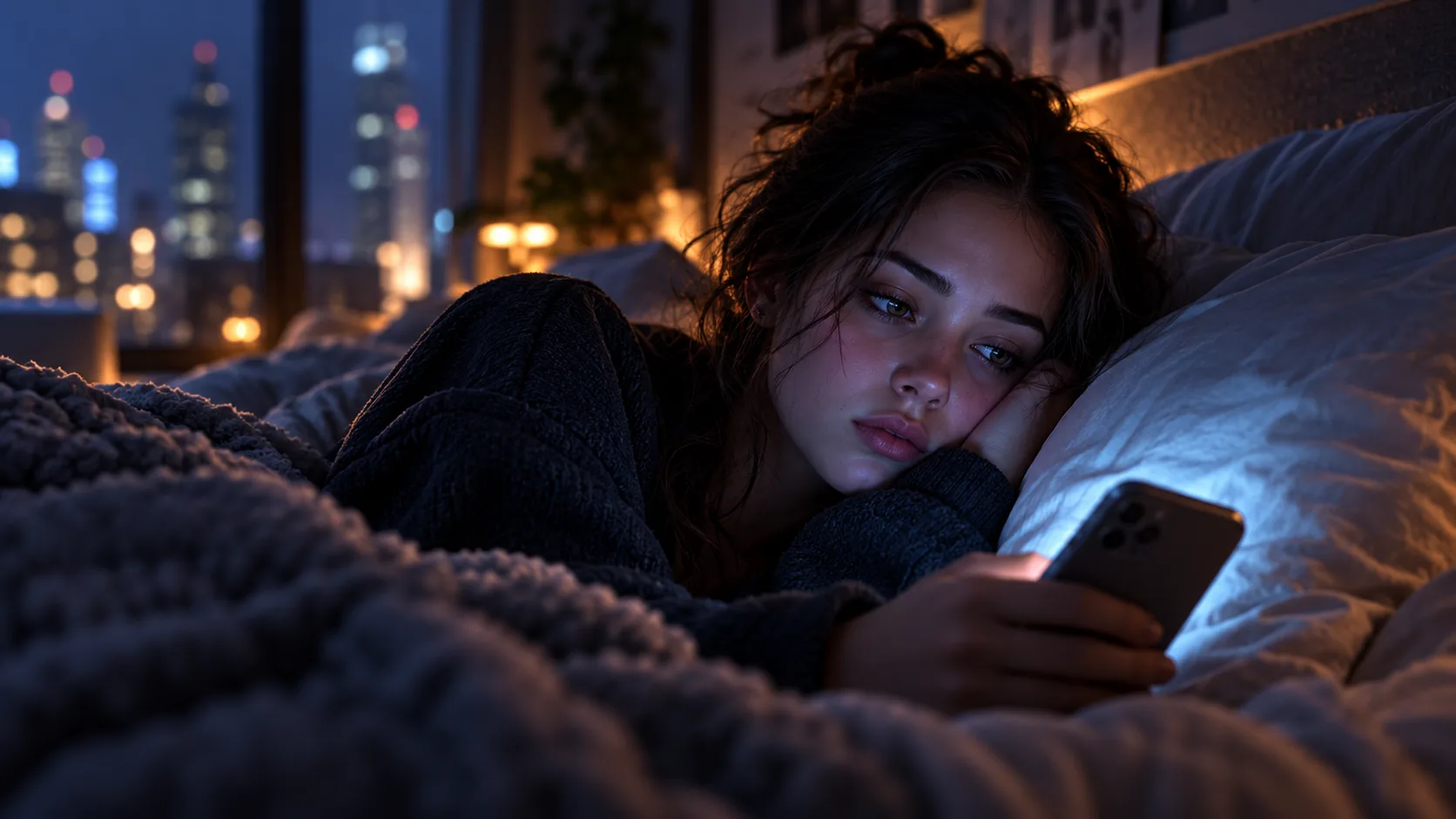
And yet, after two hours on a smartphone, a person may feel lonelier than before.
This contradiction is not proof that social media inevitably makes people lonely. The research is far more nuanced than that. But it does show that contact and connection are not the same thing.
A person can have hundreds of contacts and nobody they would call in the middle of the night. They can receive messages every day and still feel misunderstood. They can constantly see how other people live, celebrate, travel or conduct relationships – and develop the feeling that they themselves are standing outside that life.
So the real question is not: Does social media make us lonely?
It is: When does it help us maintain relationships – and when does it merely create the feeling of being connected?
Loneliness is not the same as being alone
Loneliness is often confused with a lack of contact.
The World Health Organization clearly distinguishes between social isolation and loneliness.
Social isolation describes a more objective situation: a person has only a small number of relationships, roles or regular social contacts.
Loneliness, by contrast, is subjective. It arises when there is a painful gap between the relationships a person actually has and the relationships they want or need.
That is why someone can live alone without feeling lonely.
And someone can be married, speak with colleagues every day, have many friends on social networks and still feel lonely.
This distinction is crucial when discussing social media. Platforms can increase the number of contacts without automatically improving the quality of relationships.
Loneliness is not a marginal phenomenon
In 2025, the WHO Commission on Social Connection published its major report on loneliness and social isolation.
According to the data compiled there, roughly one in six people worldwide experiences loneliness. The figures are particularly high among adolescents and young adults. Among adolescents, the WHO puts the proportion at about 21 percent.
Loneliness is therefore not a problem affecting only a small social group, nor is it exclusively an issue of old age.
It affects people in different countries, age groups and life situations.
Its causes are varied: health problems, separations, moving home, financial difficulties, bereavement, limited social support, discrimination or major changes in a person's life.
Social media can therefore never be the sole explanation.
Rather, it is part of a society in which the way people communicate and maintain relationships has changed.
More contacts do not automatically mean more closeness
One of social media's major strengths is its reach.
People who in the past might have almost completely disappeared from one another's lives after a move or a change of school can now remain reachable for years.
Families can stay in contact across continents. Migrants can speak with relatives in their country of origin. People with rare illnesses, specific interests or experiences of social exclusion can find communities that may not exist at all in their immediate surroundings.
That is real social connection.
But the same platforms can also create a second kind of contact: relationships that are visible but thin.
You know the name. You see the photos. You occasionally react with an emoji. You may know where someone is on holiday or which restaurant they visited.
But you do not know how that person is really doing.
Digital networks make it possible to maintain a very large number of relationships simultaneously at a low level of intensity. That can be useful. It becomes problematic when those contacts are treated as a substitute for relationships in which trust, reliability and mutual support develop.
A “like” is a social reaction.
But it is not automatically closeness.
Why constant availability can make closeness less visible
In the past, contact was often an event.
People deliberately made a phone call. They visited someone. They wrote a letter. They arranged a place to meet.
Today, communication often runs permanently in the background.
A message here. A photo there. A voice note answered later. A short video. A meme. A reaction to a story.
This communication is not worthless. Quite the opposite: small everyday interactions can help sustain relationships.
But permanent communication can also create an illusion.
Because something is always happening, it can feel as though we are constantly connected to other people. At the same time, conversations in which someone truly listens, asks follow-up questions or stays with one subject for longer may become less frequent.
There can be a great deal of communication without necessarily being a great deal of encounter.
The problem is not simply screen time
Research makes an important distinction that is often lost in public debate.
It would be too simplistic to say:
The more time someone spends on social media, the lonelier they become.
A systematic review and meta-analysis published in 2026 examined 59 studies involving more than 81,000 adolescents and young adults in total.
The findings were nuanced.
The amount of time people spent on social media showed only a small association with loneliness.
The association was considerably stronger for problematic social media use – patterns of use that become compulsive, difficult to control or disruptive to other areas of life.
The authors found a moderate association between problematic use and greater loneliness. The association with time spent using social media alone was substantially smaller.
That is an important distinction.
Two people can spend two hours a day on social platforms and have completely different experiences.
One uses them to arrange real-life meetings, speak with close friends and stay in touch with family.
The other spends two hours scrolling, comparing themselves with others and finishes feeling as though they do not belong.
The clock alone does not explain the difference.
Social media does not automatically make people lonely
This also needs to be stated clearly.
A scientific review published in 2025 concluded that social media overall is only weakly associated with loneliness and explains relatively little once other factors are taken into account.
Research does not support the simple claim:
Social media causes loneliness.
The relationship can work in both directions.
People who are already lonely may use social media more often because they are seeking contact.
At the same time, certain forms of use can intensify existing loneliness.
Other forms of use can promote connection.
The most interesting question, therefore, is not whether social media is “good” or “bad”.
What matters is what a person does there, who they interact with and what that use does to their offline social life.
The difference between watching and participating
A social network can feel like a large room full of people.
But not everyone is in that room in the same way.
Some people write, debate, arrange meetings and have conversations.
Others mostly watch.
They see weddings, birthdays, trips, promotions, new homes, restaurants, groups of friends and happy moments.
The problem is not that these images are necessarily false.
The problem is selection.
People rarely share the ordinary, unfiltered reality of their lives. They share selected moments.
Someone who sees those excerpts one after another may begin comparing their own everyday life with the highlights of dozens of other people.
One holiday photograph is harmless.
A hundred such images can create the impression that everyone else is constantly travelling, succeeding, in love, invited somewhere or happy.
By comparison, one's own quiet weekend can suddenly feel like a personal shortcoming.
When comparison becomes a social measuring stick
People have always compared themselves with others.
Social media did not invent that mechanism.
But it has given it a new speed and reach.
In the past, someone might have compared themselves with neighbours, colleagues or a few friends.
Today, within a matter of minutes, comparison can encompass people from different countries, social classes and ways of life.
Platforms may also give greater visibility to particularly striking content.
Extraordinary trips, spectacular bodies, luxurious homes, unexpected successes or emotionally charged relationships attract attention.
The ordinary Tuesday of a contented person is far less visible.
That creates a distorted benchmark.
Not necessarily because anyone is deliberately trying to deceive, but because social media turns many individual choices about what to show into a shared stage on which the exceptional is disproportionately present.
Fear of Missing Out: the feeling that real life is happening somewhere else
The term Fear of Missing Out, or FoMO, has become established for this phenomenon.
It describes the concern that other people are currently experiencing something from which one is excluded.
An evening at home can be perfectly pleasant.
Until the screen shows friends eating together, celebrating or travelling.
Suddenly, the meaning of one's own evening changes.
Not because anything has objectively changed.
But because it has become visible what is happening elsewhere at the same time.
Social media has turned what used to be a more occasional feeling into a potentially permanent experience.
You no longer merely hear that an event took place.
You can follow it almost in real time.
That can create a sense of belonging when you are involved.
It can make exclusion painfully visible when you are not.
Many friendships are easier to maintain – but do not automatically become deeper
Social media solves a genuine problem of modern life.
People move. They change jobs. They study in other cities. Families live in different countries. Groups of friends become geographically dispersed.
Digital communication prevents every physical separation from automatically becoming the end of a relationship.
That is a major advantage.
But relationships require more than availability.
Depth often develops through shared experiences, trust, reliability, conflict, reconciliation, repeated encounters and the feeling that someone will be there when it really matters.
A friendship can be maintained through messages.
But it can also gradually become a contact in which both people still know what the other publishes, while barely knowing what is occupying their mind.
The difference is subtle.
And that is precisely why it can go unnoticed for a long time.
Why you can still feel excluded in a group
Loneliness does not necessarily mean having nobody.
Sometimes it means not feeling seen within relationships that already exist.
Group chats illustrate this problem particularly clearly.
A person can belong to several groups, receive messages every day and still feel that their own presence makes no difference.
They read along.
They react.
But if they say nothing for several days, perhaps nobody asks where they are.
A sense of belonging does not arise merely from technically being part of a group.
People want to feel that their presence is noticed.
That someone misses them.
That a relationship does not exist merely because a platform has stored it in a contact list.
Young people are particularly affected – but they are not the only ones
WHO data show particularly high levels of loneliness among young people.
At first, that appears paradoxical.
Adolescents and young adults in particular are often highly connected digitally.
Yet this stage of life also contains many social transitions.
Changing schools, university, first jobs, moving, relationships, break-ups and the search for one's own identity can all alter existing social structures.
Social media runs through all of these changes.
It can provide stability because old contacts remain reachable.
But it can also amplify every social comparison.
Adults experience other forms of loneliness: work pressure, family responsibilities, separation, moving or the gradual disappearance of close friendships from everyday life.
For older people, digital communication can in turn be particularly valuable when mobility is limited or family members live far away.
Here too, the research is not uniformly negative. Meta-analyses involving older adults explicitly examine the circumstances under which social media can reduce loneliness.
There is therefore no single effect of social media.
There are different people, in different circumstances, using it in different ways.
When the feed replaces the feeling of really knowing someone
Social media provides information about other people.
But information is not automatically a relationship.
Someone who sees a former friend's posts every day may feel as though they are still participating in that person's life.
They may know where that person travelled, what they ate and who they spent time with.
Yet when they meet in person after two years, they may realise how little they know about the things that matter.
How are they really doing?
What are they worried about?
What has changed?
What keeps them awake at night?
A feed can simulate familiarity.
Closeness usually requires more.
Algorithms are not the whole explanation
It would be tempting to blame the problem entirely on algorithms.
That too would be too simple.
Platforms do help determine which content becomes visible. Systems optimise feeds using signals such as attention, interaction or inferred interest.
That influences what people see.
But loneliness does not arise from a recommendation algorithm alone.
It has personal, social, economic and societal causes.
A person may feel lonely because they moved away.
Because a relationship ended.
Because friends had children and have less time.
Because work dominates everyday life.
Because illness makes encounters more difficult.
Because they do not feel accepted in their surroundings.
Technology can intensify or soften such situations.
But it does not replace the full explanation.
Why social media can still be valuable for lonely people
People who feel isolated can find online something they may lack offline.
A community.
Other people with similar experiences.
Information.
Someone to talk to.
For minorities, people with rare illnesses, migrants, people with disabilities or those living in remote areas, digital spaces can have an importance that is easy for outsiders to underestimate.
Introverted or socially anxious people may also find it easier to initiate contact online.
The decisive question is whether those contacts create connection over the long term or merely cover over a feeling of emptiness for a short time.
A digital friendship can be a real friendship.
A relationship does not have to take place in the same room to be meaningful.
But digital relationships also require reciprocity, trust and attention.
What problematic use changes
Problematic social media use does not simply mean being “online a lot”.
Use becomes more problematic when it is difficult to control and begins to displace other parts of life.
When someone wants to sleep but keeps scrolling.
When meeting someone seems less interesting than the feed.
When a person's mood increasingly depends on how many reactions a post receives.
When social media is no longer mainly a tool or entertainment but becomes an automatic response to boredom, stress or loneliness.
A cycle can develop.
Someone feels bad and opens a platform in search of distraction or connection.
For a short while, it works.
Afterwards, they may feel just as lonely – or even worse because of comparison.
So they open the platform again.
That is precisely why research finds a considerably stronger association between problematic use and loneliness than between loneliness and time spent using social media alone.
What real connection consists of
The WHO does not describe social connection only in terms of the number of relationships.
It also considers their function and quality.
That is a useful measure.
A relationship is not valuable merely because it exists.
What also matters is:
Can I trust this person?
Can I get help?
Can I offer support myself?
Do I feel respected?
Can I be honest?
Can I be silent without constantly having to perform?
Those questions cannot be translated into follower counts.
A person with three dependable relationships may be more socially connected than someone with three thousand contacts.
Why loneliness matters to society
Loneliness is often treated as a private feeling.
But its consequences extend further.
The WHO points out that social isolation and loneliness are associated not only with psychological distress but also with physical health and increased mortality.
The WHO Commission's report therefore explicitly describes social connection as an important issue for public health and society.
That does not mean every lonely weekend should be medicalised.
Temporary loneliness is part of human life.
It becomes problematic when it persists and people can barely see ways to build or maintain stable relationships.
At that point, it affects not only individual life satisfaction but also education, work, health and social cohesion.
What can help against digital loneliness
The obvious answer would be: put the smartphone away.
It is not that simple.
For some people, less social media would help.
For others, it would cut off important contacts.
A more useful question is:
Which kind of use leaves me feeling more connected afterwards – and which leaves me with even more emptiness?
Some practical differences matter.
A personal conversation is not the same as endless scrolling.
A message to a specific person is not the same as observing a hundred strangers' lives.
A meeting arranged online can turn social media into the starting point for a real encounter.
A group chat can provide support when people are genuinely there for one another.
The issue, then, is less about blanket digital abstinence than about the quality of use.
Five questions that say more than screen time
Anyone who wants to know whether social media is good for their social life can ask questions other than simply: “How many hours was I online today?”
1. Am I talking with people, or mostly watching other people?
2. Do I feel more connected after using it, or worse than before?
3. Do digital contacts help me maintain relationships – or do they replace encounters I actually miss?
4. Are there people I can honestly tell when I am not doing well?
5. Would anyone notice if I withdrew completely for a few days?
These questions do not measure perfect social health.
But they come closer to the real meaning of connection than follower counts or screen-time minutes.
Being connected is not the same as feeling connected
Social media has not abolished relationships.
It has changed them.
It enables closeness across distance, preserves contact, creates communities and gives people access to social spaces that would scarcely exist without digital technology.
At the same time, it can create a form of closeness based mainly on visibility.
We see one another.
We follow one another.
We react to one another.
And yet sometimes the feeling of truly mattering is missing.
Research therefore argues against simple blame.
Not every intensive use of social media causes loneliness. Not every digital relationship is superficial. And using less social media does not automatically lead to better friendships.
But one thing remains true regardless of the platform:
People need more than contact. They need relationships in which they feel noticed, understood and needed.
A screen can help with that.
But it cannot guarantee it.
Sources and further reading
- World Health Organization – Report of the WHO Commission on Social Connection (2025): “From loneliness to social connection: charting a path to healthier societies.”
- World Health Organization – Social connection: Questions and answers (30 June 2025).
- Feng H-P et al. – Social Psychiatry and Psychiatric Epidemiology (2026): “Exploring the relationship between social media use and loneliness in adolescents and young adults: a systematic review and meta-analysis.”
- Hall JA – Annals of the New York Academy of Sciences (2025): “Loneliness and social media.”
- Social media in the adult population – Computers in Human Behavior Reports (2025): systematic review on social-media use, well-being, self-esteem, anxiety, depression and loneliness.
- Jin J, Kim HK – Journal of Health Psychology (2025): meta-analysis on social-media use and loneliness among older adults.