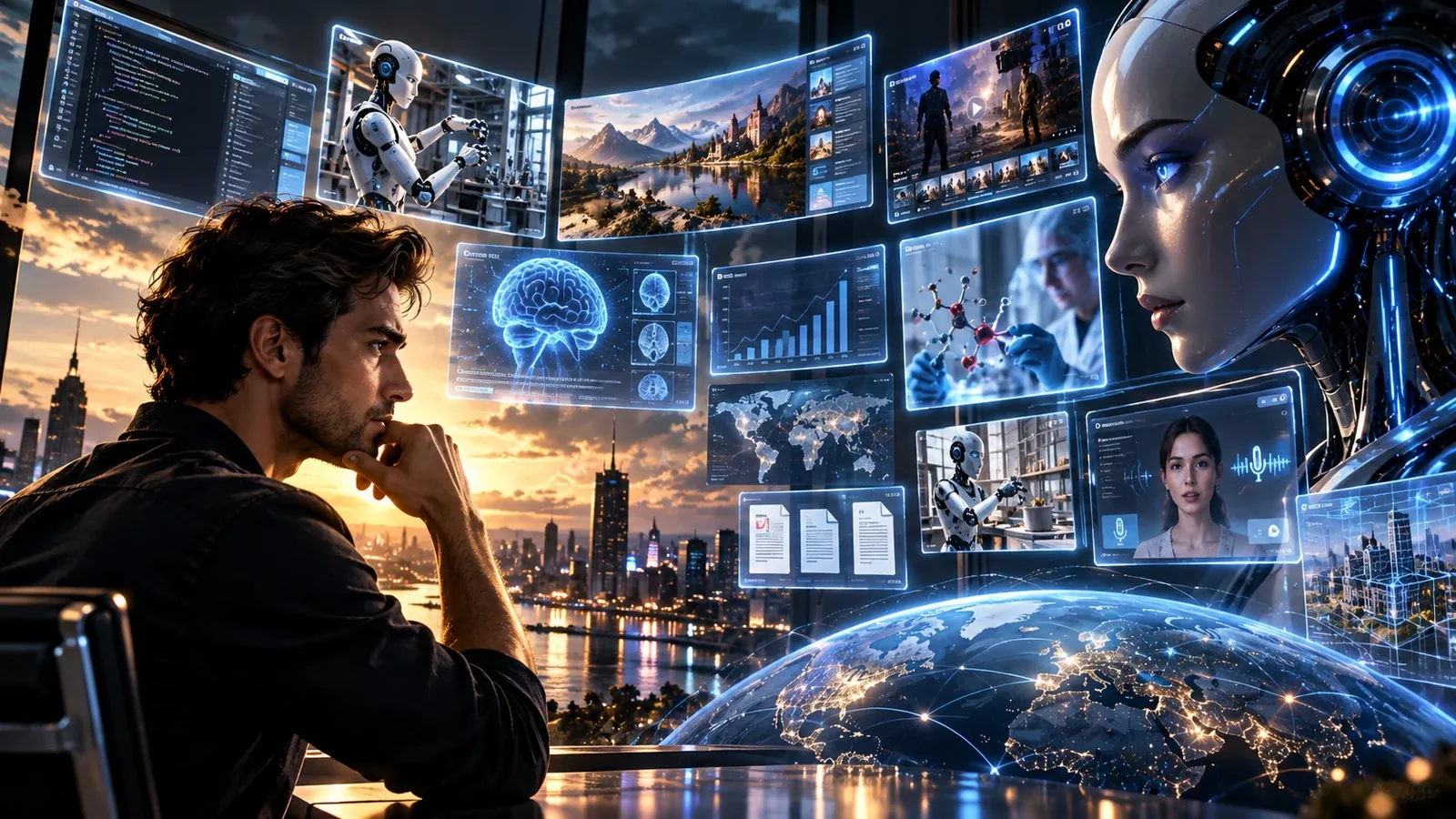
An AI system can write software, analyse hundreds of pages, create images and work through a multi-step task. Then it is shown an analogue clock and gets the time wrong. That apparent contradiction is one of the clearest descriptions of AI in 2026.
Impressive capability, but an uneven frontier
The Stanford AI Index 2026 describes a jagged frontier. Leading systems can perform exceptionally well in mathematics, science and multimodal reasoning while still failing at simple visual tasks. Stanford cites analogue-clock tests where the best system was around 50 percent accurate.
A high benchmark score therefore does not mean general intelligence or universal reliability.
From answering to acting: the rise of AI agents
The major shift of 2026 is agents that can chain actions: search documents, open websites, edit files, execute code, check results and continue.
OpenAI describes this as a move from chat toward longer-running delegated work. The important advance is not just better language; it is coordinating tools and actions.
Coding is one of AI’s strongest areas
Coding agents can inspect projects, modify several files, run tests and fix errors. Benchmark performance has risen rapidly, although some benchmarks are becoming saturated and less representative of real work.
Human expertise remains important for goals, architecture and oversight.
Images and video have crossed another threshold
Image models are more coherent, photorealistic and precise at editing. For designers, publishers and creators, the cost of visual experimentation has fallen sharply.
Video is following the same path. Systems such as Veo can generate sequences from text or images and increasingly integrate audio and dialogue, although long continuity and precise direction remain difficult.
AI is increasingly multimodal
Frontier systems can work with text, images, audio, video, tables and documents in one workflow. That opens much richer tasks.
It also makes errors more complex because a misunderstanding can propagate across different kinds of information.
Using a computer is becoming an AI capability
Benchmarks such as OSWorld test whether agents can click, navigate applications and complete tasks in graphical interfaces. Progress is substantial, but failures remain common.
A system that succeeds most of the time may be useful for experimentation but is not automatically suitable for banking, medicine or industrial control.
Reliability matters more than an impressive demo
A mistake in a restaurant booking has a different cost from a medical error or wrong bank transfer. The higher the stakes, the less useful it is to say simply “AI can do this”.
The practical question is whether it can do it reliably enough under real-world conditions.
Science, medicine and robotics show both promise and limits
AI already supports work in chemistry, biology, weather and medicine. On narrow tasks, systems can outperform average experts; reproducing a complete scientific study remains much harder.
Robotics shows the same gap between controlled environments and physical reality. A real kitchen is full of misplaced objects, people and surprises.
In 2026, AI becomes more than a chat window
It writes, sees, listens, generates images and video, uses tools, works with files and begins to act in the physical world. At the same time, hallucinations, simple mistakes and brittle behaviour remain real.
AI is neither just autocomplete nor an artificial human. It is a new class of systems that can be extremely strong in some domains and surprisingly weak in others.